Transformational Timelines
- “I know him! He’s a friend of mine.”
- “She’s really nice. I work with her. Sure, I know her.”
- “They’re OK. I see them walking their dog. How bad could they be?”
- “Well, all I can say is that he IS my boss, but I know his type.”
- "You know them. They all drive like that. None of them should have a license."
We might claim that we ‘know’ these people because of our interactions with them here and there. Our social cognition rings true because our brains are wired to categorize people and groups within milliseconds. (For more: Google Search, "How our brains categorize people and groups.")
Let's try a case study. Do you know me?
Some of you have more experience with me than the vast majority. Some of you might think you know me because you have read some of the nearly 500 “Sandals and a Stick” articles. A good start, of course.
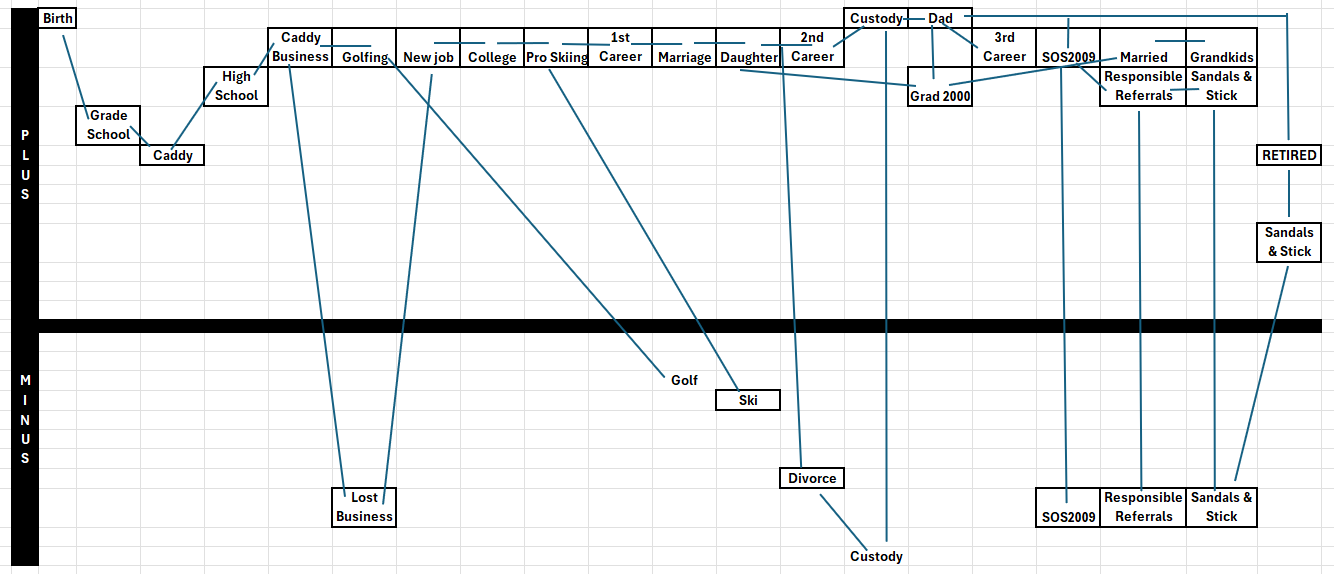
I heard about life-story timelines a week or two ago. Intrigued, I put this one together. Maybe someday, I'll significantly expand this just for fun. Obviously, this timeline reflects only a few lifetime events occurring over a significant number of decades.
Above the heavy black line are positive events and below are the unfortunates. One might conclude I am an optimistic person since there are more plus than minus events. That would be a guess and probably a mistake.
For today, I chose to examine the lower half, The red arrows point to each reported negative event. This decision was made because I think sometimes, it's the negative outcomes that make the most long-lasting impacts.
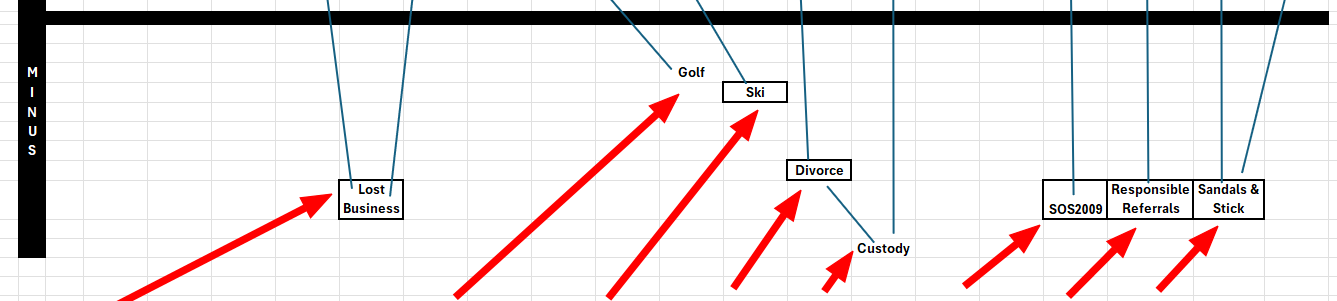
If we wish to know someone, we will need time to explore these "unfortunates." We will need answers to questions like these.
- When exactly did this event happen?
- How long did it last?
- What emotional feelings were involved when the event happened?
- Did this event shift a worldview?
- How did this event affect decision making going forward?
- Did the event affect any relationships either at once or long term?
- Why did this happen?
- Was it a result of a bad decision?
- Who made this decision?
- Were there several decisions leading up to the final decision?
- Was the decision made due to external forces?
This timeline exercise can also be applied to people groups. What can we possibly know about:
- A family of Mexican immigrants even if we met a member or two of this group?
- A community of LGTBQ+ people just because we read something on Facebook?
- A pregnant girl and the decisions made with her parents and doctors?
Going beyond individual timelines, what about those facets of life decided by social systems? Not only is an individual life-story important, but we also need to include a group or cultural timeline. As complicated as this is, we need to decide if we have any basis for a competent understanding of the group being examined. What do we know of,
- The historic and systemic consequences of Redlining on potential Black home buyers,
- The 'glass ceiling' roadblocks which continue to guarantee financial distress for generations of women,
- The 'sounds good on the surface' voter ID laws that are designed to prevent people of color from voting,
- The 'sounds good on the surface' law and order occupation of US cities designed not so much for law and order but for intimidation, persecution, and deportation while treating every immigrant as a criminal,
- The national move to limit solutions for those experiencing HIV, Poverty, Homelessness, or Suicidal, Mental Health, or Gender issues,
- The attitude of pick-yourself-up-by-your-bootstraps-or-you-are-lazy being applied to people systemically and generationally preventing them from obtaining education, jobs, and financial independence.
Maybe you don't want to know about any of these individuals or their group affiliations.
Maybe you can devote little time to the research required to discover red arrow answers.
Maybe you just want me to stop.
I completely understand that last one. I will be happy to oblige with just two last points.
ONE - I've explored this topic before, and I encourage you to review these two articles.
- "Blood, Sweat, and Tears (May 2022), and
- "I See You" (August 2017) which also includes a very interesting video.
TWO - We are in the Season of Lent.
Holy Thursday arrives on April 2. Let’s pay close attention to the story of the Last Supper. Even knowing betrayal is imminent, feet are washed.
Ten minutes washing the feet of those we fear might just be the best way to begin to know and understand another person. But wait! There is good news.
It is not necessary to carry around a bucket of warm water, soap, sponges, and towels. We can "wash feet" with the compassion and empathy of our own heart whenever we choose to listen to the stories of Blood, Sweat, and Tears. When we're finished, we will be able to look people in the eye with a conviction that says, "I See You."