As Far as East is from West
He is Risen! He is Risen, indeed.
Happy Easter!
Masses of people will celebrate this holiday with colored eggs, chocolate bunnies, and ham, while gathering with family. We celebrate with you!
Masses of people will celebrate this holiday remembering Holy Thursday, Good Friday, and Easter Sunday. We celebrate with you!
For those who are remembering, I have a couple of comments. But nevertheless, the remarks are useful for all of us, spiritual or not.
Holy Thursday: Jesus, as a servant leader, washes the feet of his disciples, later saying, “A new command I give you. Love one another as I have loved you.” (John 13:34-35). Do we ever, even metaphorically, wash the feet of those we love? Would we even consider doing this for those who betray us?
Good Friday: The day of Crucifixion. The day that curtain between the faithful and God was torn in two from top to bottom. A curtain nearly 4 inches thick, 60 feet tall, and 30 feet wide that required hundreds of men to manage it, was destroyed and so was the separation between God and us.
Easter Sunday: A group of women (including Mary Magdelene) braves the wrath of the Roman government to visit the tomb of Jesus finding that He is risen, just as he said he would.
But Holy Week starts, of course, with Palm Sunday. And this has been front and center for me this year. You remember the story; the celebration, the hosanas shouted as palm branches were laid on the street in front Jesus arriving at Jerusalem. I might have quickly moved on from there, as usual, but listening to one preacher, things were said that gave me pause - especially considering our current situation.
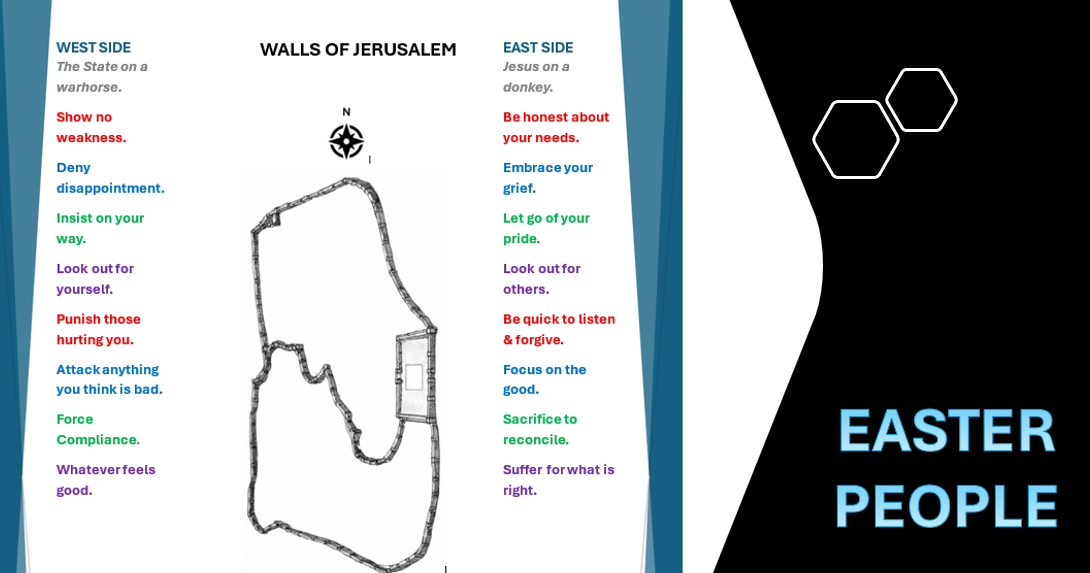
I had always been exposed to the East entrance to Jerusalem used by Jesus on this occasion. But I heard that Pontius Pilate was also in residence that day. He entered the city riding on a warhorse with a parade of military might, his job defined. Keep control.
I was struck as the polarized difference between these two parades was explained: The understated Jesus riding a donkey at the minor East Gate (the back door, if you will) versus a warhorse ridden by Pilate in procession that included a military show of force entering the main gate in the West wall. The discrepancies don’t stop there.
Everything that happened painted a picture of two kingdoms. A kingdom of power-over control versus a kingdom of power-under service and humility.
The Pontius Pilate Parade of Roman culture
- focused on wealth, status and fame. If you lacked these things, it was your fault – you deserve to be poor. Strong matters. Weaknesses and vulnerability are for losers. No need for compassion and empathy. Everyone gets what they deserve.
- was concerned about winning. Never admit failure. Hide the truth at all costs. Let nothing make you look foolish. Crush everyone that can out you. Cover it up. Misdirect. Deflect. And lie. The lie is good – it protects you. The truth about failure makes you look weak. Weaknesses are unacceptable.
- treated success as a zero-sum game. Might means right. If you want it, let nothing get in your way. Aggression and oppression are good if it serves personal benefit. Nobody deserves mercy. No second chances. Succeed or suffer the consequences.
- understood that judgment is necessary. Decide. This something or someone serves me well. Good. When the service is no longer needed, it becomes bad and must be discarded. Cruelty is not out of the question.
- loved peace. Pax Romana. Use fear, intimidation, and severe punishment to coerce the population to conform. Punish all dissentions. When all disagreement is eliminated, peace will reign.
The Jesus Kingdom on Earth Parade contradicts everything Roman life considered sacred. It's as far as East is from West.
A sacrifice on a Roman-built cross put to death those cultural tenets. The Risen Lord gave life to a New Kingdom of Heaven. This is Easter.
We need to choose our 'parade' and by doing so, we are confirming our allegiance to the kingdom represented by each procession. To adopt and claim Roman philosophies means that we will stay behind the curtain that was already torn. It is to choose to remain separated from God Himself. It is to choose a life of Roman peace under aggressive oppression instead of the peace of freedom offered by Jesus.
"Now when Jesus saw the crowds, he went up on a mountainside and sat down. His disciples came to him, and he began to teach them. He said:
“Blessed are the poor in spirit,
for theirs is the kingdom of heaven.
Blessed are those who mourn,
for they will be comforted.
Blessed are the meek,
for they will inherit the earth.
Blessed are those who hunger and thirst for righteousness,
for they will be filled.
Blessed are the merciful,
for they will be shown mercy.
Blessed are the pure in heart,
for they will see God.
Blessed are the peacemakers,
for they will be called children of God.
Blessed are those who are persecuted because of righteousness,
for theirs is the kingdom of heaven."
“Blessed are you when people insult you, persecute you and falsely say all kinds of evil against you because of me. Rejoice and be glad, because great is your reward in heaven, for in the same way they persecuted the prophets who were before you."
The above is found in Matthew 5. It’s the beginning of the Sermon on the Mount and commonly referred to as the Beatitudes. I pull this out several times each year for a refresher. You’ll notice that there is nothing here that reflects the policies and beliefs of life in the Roman Empire. There is nothing here that reflects our current culture's common philosophies either. That speaks volumes.
To believe in a Holy Week culminating in Easter, it seems that we need to adopt and follow the teachings that come before the Resurrection. If we miss these lessons, if we do not become a transformative light, a calming peacekeeper, and a justice advocate for all people, I don't know how we defend celebrating our role as Easter People.
For me, I reject the ancient Romanesque philosophes as well as those in existence yet today. I will invest in a priority refresh starting with that Sermon on the Mount. Maybe I'll be able to keep those parades in mind throughout the year. Well, that's my prayer, anyway.
Happy Easter!
Thank you, Adam Smith, for your Palm Sunday insights.